Missed Call Insights Report Capabilities
The department missed calls report helps:
- build an effective motivation system for employees and quickly calculate payroll based on KPIs for missed calls;
- evaluate how employees handle missed calls — how long customers wait for a callback and how many customers remain unprocessed;
- understand why calls to the department went unanswered and which employees miss them more often.
I. Analyze Why Calls Were Missed and Their Volume
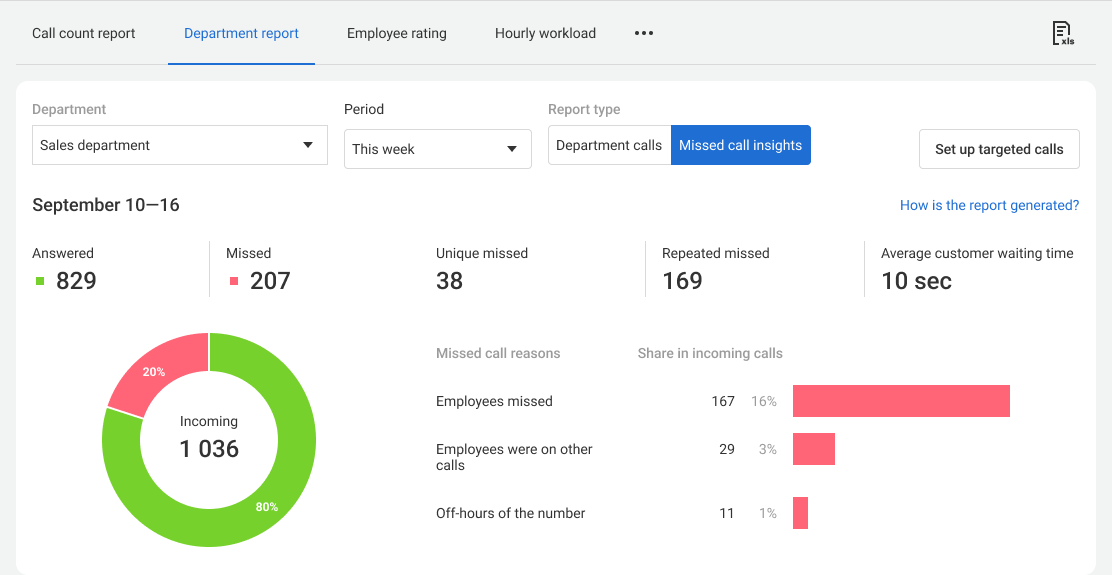
The quantity of answered and missed calls, as well as their share among all incoming calls shows how effectively the department handles incoming volume at a high level. The following metrics provide deeper insight:
- quantity of unique missed calls — how many real customers are represented in the total volume of missed calls;
- repeated missed calls — how many times customers tried to call the department again;
- average customer waiting time — how long customers wait on average for the department to answer (until an employee answers or the customer hangs up);
- missed incoming call reasons — what share of potential customers was lost due to employee performance issues, insufficient department resources, or the current work schedule (if customers call outside the department’s working hours).
If in most cases employees miss calls, consider introducing KPIs for missed calls and tracking them for each employee.
If more calls are missed because *employees were on other calls*, your department may be overloaded and you may need to increase the number of employees per shift.
If missed calls occur *during off-hours*, you may need to review the schedule or call distribution settings, for example, by assigning an on‑duty employee.
II. Evaluate How the Department Processes Missed Calls from Customers
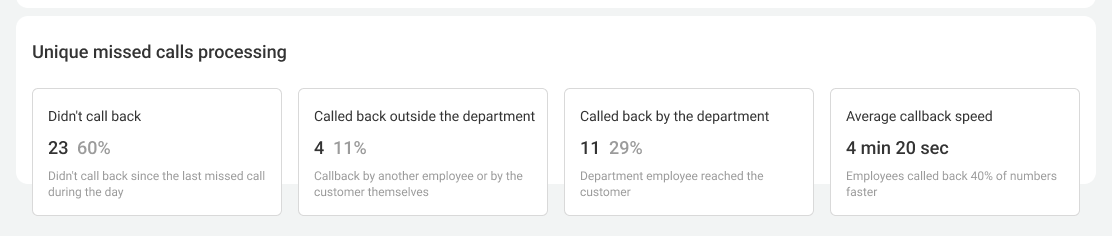
By unique missed calls in the report, you can track callback statuses to respond to the current situation:
- Didn’t call back — the quantity of potential customers lost due to not returning missed calls within the calendar day. If you are analyzing yesterday’s or today’s report, go to the call history to get the list of customer numbers and assign employees to call them back;
- Called back outside the department — the customer called again and reached someone, or the callback was made by employees from another department;
- Called back by the department — the share of missed customer calls that were handled by your department’s employees;
- Average callback speed — how quickly, on average, your employees return missed calls and what share of calls is processed faster.
III. Identify Who Misses Most Calls
Evaluate how each department employee missed and processed missed calls:
- Department’s missed call contribution share — how much an employee is responsible for the department’s missed calls and what share of missed calls they could have answered but did not;
- Total calls distributed to the employee — how often calls were routed to the employee. If there are significant imbalances in the quantity of distributed calls between employees, you should identify the cause. The department's call distribution may be misconfigured, or the employee may frequently use Do not disturb mode during working hours;
- Missed calls distributed to the employee — how often the employee misses calls routed to them. The department's missed call contribution share may be high because there are few such calls overall, while the employee rarely misses calls;
- Declined by the employee — whether any employee avoids handling incoming calls by rejecting them (declined calls include calls the employee rejected without picking up the phone);
- Callback attempts for department’s missed calls — how actively the employee participates in returning department’s missed calls;
- Callback attempts per number on average — how motivated the employee is to reach the customer rather than calling just formally.
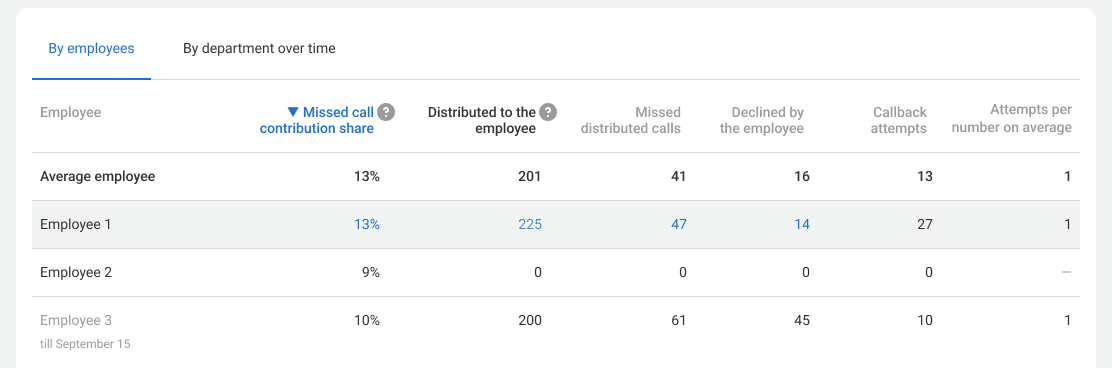
Employees removed from the department during the analyzed period are highlighted in gray.
IV. Review Missed Calls by Department Over Time by Day, Week, and Month
The Department over time table shows how key metrics listed above change over time — whether customer waiting time and missed calls improve or worsen, as well as the processing of missed calls.
You can also easily track how these metrics relate to each other here. For example, average customer waiting time, together with the share of missed calls among all incoming calls and the breakdown of missed calls by their reasons shows how long customers are willing to wait for an answer and what actions can reduce missed calls (adding employees, improving response speed, etc.).
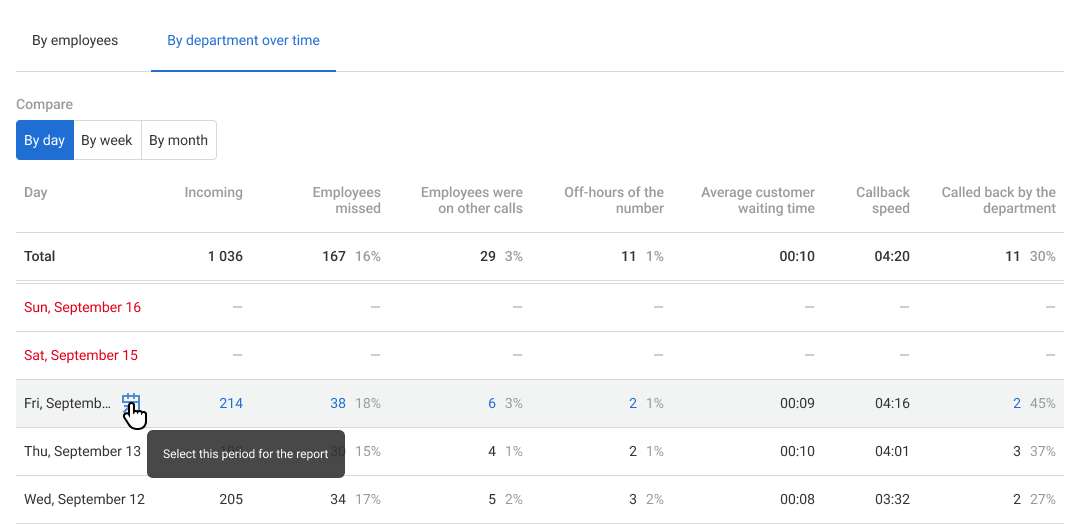
To view the report for a specific period, click the calendar icon next to the corresponding dates.
You can also download the report in Excel to evaluate results alongside other performance metrics, for example, sales.